
Michigan Bankruptcy Process Explained: What Happens After You File
Facing mounting bills and relentless collection calls feels impossible to escape for many Michigan families. Bankruptcy is not a personal failure but a legal tool offering real hope and a fresh start, with protections that stop collection activities immediately and shield essential assets under Michigan law.
Understanding the differences between Chapter 7 and Chapter 13 can help you separate fact from fiction, clear up common myths, and focus on real solutions for long-term financial stability.
Bankruptcy Explained and Common Myths
Bankruptcy often feels like a financial failure, but it’s actually a legal tool designed to help people get unstuck. At its core, bankruptcy is a legal process that allows individuals to eliminate or reorganize their debts under federal law. When you file for bankruptcy in Michigan, you’re essentially hitting a reset button. The automatic stay that kicks in immediately stops collection calls, wage garnishments, and foreclosure proceedings. That relief alone changes everything for many Michigan families who have been drowning under relentless collection activity.
Michigan residents typically have two main options. Chapter 7 bankruptcy works like a liquidation. You file with the federal bankruptcy court, and eligible debts get wiped out completely. This process moves relatively quickly, usually wrapping up within three to six months.
Chapter 13 bankruptcy functions differently. Instead of wiping out debts, you create a repayment plan that lasts three to five years. You pay what you can afford during that period, and remaining eligible debts get discharged at the end. Both paths lead to the same destination: a permanent discharge that eliminates qualifying debts and gives you genuine breathing room.
Now let’s tackle the myths that keep people from getting the help they need. Many Michigan residents believe bankruptcy means losing their home and car, but that’s simply not accurate. Michigan has strong homestead exemptions that protect your primary residence up to a certain value. You can also keep a vehicle, typically up to a specified amount.
Another common misconception is that bankruptcy will destroy your credit permanently. Yes, it appears on your credit report, but rebuilding starts immediately. Thousands of Michiganders have filed bankruptcy and rebuilt their credit scores within a few years. The real myth is thinking your current situation won’t improve without taking action. Bankruptcy isn’t about shame. It’s about strategy.
Common myths about bankruptcy often prevent people from exploring an option that could genuinely change their financial trajectory. Many people worry they’ll never get credit again, but credit becomes available relatively quickly after discharge. Some fear they won’t be able to work in certain professions, but most careers remain accessible to bankruptcy filers.
What actually matters is understanding which path fits your specific situation. Chapter 7 works well if your debts are primarily unsecured (credit cards, medical bills, personal loans) and your income is below Michigan’s median. Chapter 13 makes sense if you have more regular income and want to keep secured assets like a home or vehicle. The choice depends on your circumstances, not on fear or misconception. Getting accurate information from experienced Michigan bankruptcy professionals separates fact from fiction and helps you make decisions based on reality, not rumors.
Pro tip: Schedule a free consultation with a Michigan bankruptcy attorney before making any decisions. Many firms, including Frego & Associates, offer confidential evaluations to help you understand exactly which option makes sense for your unique financial situation.
Chapter 7 Versus Chapter 13 Bankruptcy
Choosing between Chapter 7 and Chapter 13 feels overwhelming because the stakes are real. Your decision shapes your financial path for years ahead. These are the two most common bankruptcy options for Michigan residents, and they work in fundamentally different ways.
Chapter 7 bankruptcy functions as a liquidation process. You file your petition, and the court appoints a trustee who sells your non-exempt assets to pay creditors. What’s left gets discharged, wiping out qualifying debts in roughly three to four months.
Chapter 13 bankruptcy takes the opposite approach. Instead of liquidating assets, you keep everything and create a repayment plan spanning three to five years. You make monthly payments to a trustee who distributes money to your creditors according to the court-approved plan.
The fundamental difference comes down to time and assets: Chapter 7 moves fast but may require selling assets, while Chapter 13 protects your possessions but demands commitment over years.
Your income determines which option you can actually choose. Chapter 7 requires passing the means test, which compares your income against Michigan’s median household income. If your income falls below the median, you likely qualify for Chapter 7. If it exceeds the median, you may still file Chapter 7 if your disposable income is low enough after accounting for expenses. Chapter 13 has no means test, but it does have debt limits. As of 2024, your unsecured debts cannot exceed approximately $465,000 and secured debts cannot exceed approximately $1,395,000. These caps change annually.
More practically, Chapter 13 works best for people with regular, predictable income who can commit to a monthly payment plan. If your income fluctuates dramatically or you’re recently unemployed, Chapter 7 might be your better path.
Assets tell another part of the story. Michigan offers exemptions that protect certain property in Chapter 7. Your primary home gets protected up to a specific equity amount under Michigan’s homestead exemption. You can keep one vehicle, household furnishings, and personal items.
However, if you own a rental property, have significant equity beyond exemptions, or possess valuable collections, Chapter 7 might require liquidating those assets. Chapter 13 changes this entirely. Because you’re repaying debts through a plan rather than liquidating, you keep all your property. This matters tremendously if you’re behind on your mortgage or car payments.
Chapter 13 stops foreclosure proceedings and allows you to catch up on missed payments through your repayment plan. You keep your home and your vehicle while restructuring the debt. For Michigan families facing foreclosure, this protection alone makes Chapter 13 invaluable.
Consider also what happens to your co-signers. If someone co-signed a personal loan or credit card with you, that person remains liable in Chapter 7. Your discharge doesn’t protect them from collection activity. Chapter 13 offers different protection. It stops most collection actions against you, and the co-signer situation depends on the specific debt structure and your plan.
The timeline question matters too. Chapter 7 concludes in months. You file, go through the process, and receive your discharge within three to four months typically. Chapter 13 demands patience. You commit to three to five years of payments. For some Michigan residents, that extended timeline feels burdensome. For others, it’s the price of keeping their home and car, making it absolutely worthwhile.
Here’s a clear comparison of Chapter 7 vs. Chapter 13 bankruptcy features:
| Feature | Chapter 7 Bankruptcy | Chapter 13 Bankruptcy |
|---|---|---|
| Debt Resolution | Liquidation and discharge | Repayment plan, then discharge |
| Timeline | 3-6 months | 3-5 years |
| Asset Protection | May lose non-exempt assets | Keep all assets, restructure debts |
| Eligibility Requirements | Below median income; means test | Regular income; debt limits apply |
| Impact on Co-signers | Co-signer still liable | Some protection may apply |
| Collection Activity | Stops immediately | Stops immediately |
Pro tip: Calculate your household income against Michigan’s current median before assuming Chapter 7 is available to you. Many families who believe Chapter 7 is their only option actually qualify for Chapter 13, which might better protect their assets. A bankruptcy attorney can run this analysis quickly during your free consultation.
Eligibility, Exemptions, and Filing Steps
Bankruptcy isn’t available to everyone, and Michigan has specific rules about who qualifies and what you get to keep. Before you file anything, you need to understand eligibility requirements and how exemptions work in your state. Not meeting basic eligibility requirements wastes time and money, so getting this right from the start matters tremendously. For Chapter 7 bankruptcy, you must pass the means test. This compares your average monthly income over the past six months against Michigan’s median household income. If you’re below the median, you generally qualify. If you’re above it, the calculation becomes more complex. The court examines your monthly expenses and deductions. If your disposable income is low enough, you still qualify for Chapter 7 even with above-median income. For Chapter 13 bankruptcy, there’s no means test, but you must have regular income to commit to a repayment plan. You also cannot exceed debt limits. Your unsecured debts must be below approximately $465,000 and secured debts below approximately $1,395,000. Additionally, you cannot file Chapter 13 if a previous bankruptcy was dismissed within the last 180 days due to noncompliance with court orders.
Michigan’s exemption laws determine what property you keep. When you file bankruptcy, certain assets are protected from creditors, while others can be liquidated. Michigan allows filers to choose between state exemptions or federal exemptions under the Bankruptcy Code, whichever is more favorable.
Michigan’s bankruptcy exemptions protect homesteads, vehicles, personal property, and tools of trade up to specific dollar amounts. Your primary home receives protection up to roughly $65,000 in equity under Michigan’s homestead exemption.
You can protect one vehicle valued up to approximately $4,000. Personal property, including household goods and furnishings, gets protected up to around $12,000 total. Tools or instruments you use for your trade receive protection if essential to your livelihood.
These amounts change periodically as Congress adjusts inflation, so verify current limits with a Michigan bankruptcy attorney. The beauty of exemptions is that they let you keep essentials while wiping out debt. Without them, Chapter 7 would strip you of everything valuable.
Here is a summary of major Michigan bankruptcy exemptions and their protections:
| Exempt Asset | Michigan Protection Limit | Practical Benefit |
|---|---|---|
| Primary Residence | Up to ~$65,000 equity | Keep your home if equity is within limit |
| Vehicle | Up to ~$4,000 value | Protect one car up to limit |
| Personal Property | Up to ~$12,000 total | Secure furnishing, appliances |
| Tools of Trade | Essential work tools protected | Continue employment post-filing |
The Filing Process Step by Step
Filing bankruptcy in Michigan involves specific steps handled through the federal bankruptcy court. Here’s what happens:
- Complete credit counseling: Take an approved credit counseling course from an authorized agency. This must happen before filing and takes about two hours.
- Gather financial documents: Collect tax returns, bank statements, mortgage documents, vehicle titles, insurance policies, and all debt statements. Accuracy here prevents case delays.
- Complete bankruptcy forms: File detailed paperwork listing all your assets, debts, income, and expenses. These forms go to the federal bankruptcy court serving Michigan.
- File your petition: Submit your completed forms to the Michigan federal bankruptcy court. Filing fees exist unless you qualify for a waiver based on income.
- Attend your 341 meeting: Meet with a court appointed trustee and possibly your creditors about two to three weeks after filing. This meeting covers your finances and the bankruptcy plan.
- Complete a financial management course: Take another approved course covering budgeting and debt management. You must finish this before receiving your discharge.
- Receive your discharge: For Chapter 7, this typically happens four to six months after filing. For Chapter 13, it comes after you complete your repayment plan.
Many Michigan residents file without an attorney using court forms and guidance. However, bankruptcy involves complex decisions about exemptions, timing, and strategy. One wrong choice can cost tens of thousands of dollars in lost protections. The stakes make professional guidance worthwhile for most families.
Pro tip: Bring your most recent tax returns and three months of pay stubs to your initial consultation with a bankruptcy attorney. Having current financial documents ready allows the attorney to provide accurate eligibility analysis and exemption planning immediately, rather than scheduling a follow-up meeting later.
Immediate Effects and Legal Protections
The moment you file for bankruptcy in Michigan, something powerful happens. An automatic stay takes effect immediately, and it stops almost everything. Creditors cannot call you. Debt collectors cannot pursue lawsuits. Wage garnishments halt. Foreclosure proceedings pause.
This immediate protection changes your life the day you file. For many Michigan families buried under collection activity, the automatic stay feels like the first real relief they have experienced in months or years. The stay is automatic, meaning you do not need to ask for it or wait for court approval. It simply activates when your petition reaches the bankruptcy court.
Understand what the automatic stay actually stops. The automatic stay halts most collection efforts, including lawsuits, garnishments, and creditor phone calls. However, certain obligations continue. Child support payments still require your attention. Alimony obligations do not disappear. Criminal fines remain enforceable. Domestic support obligations are not subject to the stay. Some creditors, particularly those with secured debts like mortgage lenders or car finance companies, can request relief from the stay under specific circumstances, though this process takes time and requires court involvement.
The stay protects you from the overwhelming pressure and constant contact that characterize serious debt situations. It gives you breathing room to focus on your bankruptcy case rather than fielding calls from twenty different creditors daily.
What Happens to Your Case After Filing
Once your petition is filed, the court assigns a bankruptcy trustee to oversee your case. This person is not your enemy. The trustee’s job is to evaluate your situation fairly and ensure the bankruptcy process works as intended. In Chapter 7 cases, the trustee identifies non-exempt assets that can be liquidated to pay creditors. In Chapter 13 cases, the trustee administers your repayment plan and distributes your monthly payments to creditors. Within weeks of filing, you attend a 341 meeting, formally called the meeting of creditors.
Despite the name, creditors rarely attend. You meet with the trustee, who asks questions about your finances, assets, and debts. This meeting typically lasts 10 to 15 minutes. You answer truthfully and thoroughly. Lying at this meeting has serious consequences, including criminal charges, so accuracy matters tremendously.
After the meeting concludes, your case moves toward resolution. In Chapter 7, assuming no complications arise, you receive your discharge within four to six months. This legal discharge eliminates your obligation to repay qualifying debts. Creditors cannot pursue you afterward. In Chapter 13, you begin making monthly payments according to your court-approved plan. If you complete your plan successfully, the remaining eligible debts get discharged at the end.
Legal Protections Throughout Your Case
Bankruptcy law provides specific protections that defend your rights. Bankruptcy laws protect debtors’ rights through a structured federal process that prevents creditor abuse and ensures fair treatment. Once your discharge is granted, creditors cannot take collection actions against you for discharged debts. Creditors cannot sue you, garnish wages, or report those discharged debts to credit agencies as active accounts. Creditors who violate the discharge injunction face legal consequences.
Additionally, Michigan law provides protections against retaliation. Employers cannot fire you simply because you filed bankruptcy. Creditors cannot harass you through collection calls after your case closes. These protections exist in the bankruptcy code itself, backed by federal courts.
One critical protection involves your exemptions. As discussed earlier, certain property remains yours throughout bankruptcy. Creditors cannot touch exempt assets. This protection exists because the law recognizes that debtors need the basic tools to rebuild their lives. You cannot rebuild anything if the court strips away your home, vehicle, and personal belongings.
Pro tip: Document all collection calls and letters you receive before filing bankruptcy. If creditors continue contacting you after your automatic stay takes effect, report violations immediately to your bankruptcy attorney. Creditors who ignore the stay can be held liable for damages, which sometimes results in financial recovery for you.
Risks, Costs, and Credit Impact
Bankruptcy solves debt problems, but it creates new ones you need to understand before filing. The process has real costs, genuine risks, and measurable consequences. Ignoring these realities leads to poor decisions. Many Michigan residents expect bankruptcy to be painless, then get shocked by what actually happens.
Being realistic about downsides helps you make informed choices and prepare mentally for what comes next. Yes, bankruptcy eliminates debt. Yes, it stops collection activity. But the path forward requires acknowledging the trade-offs.
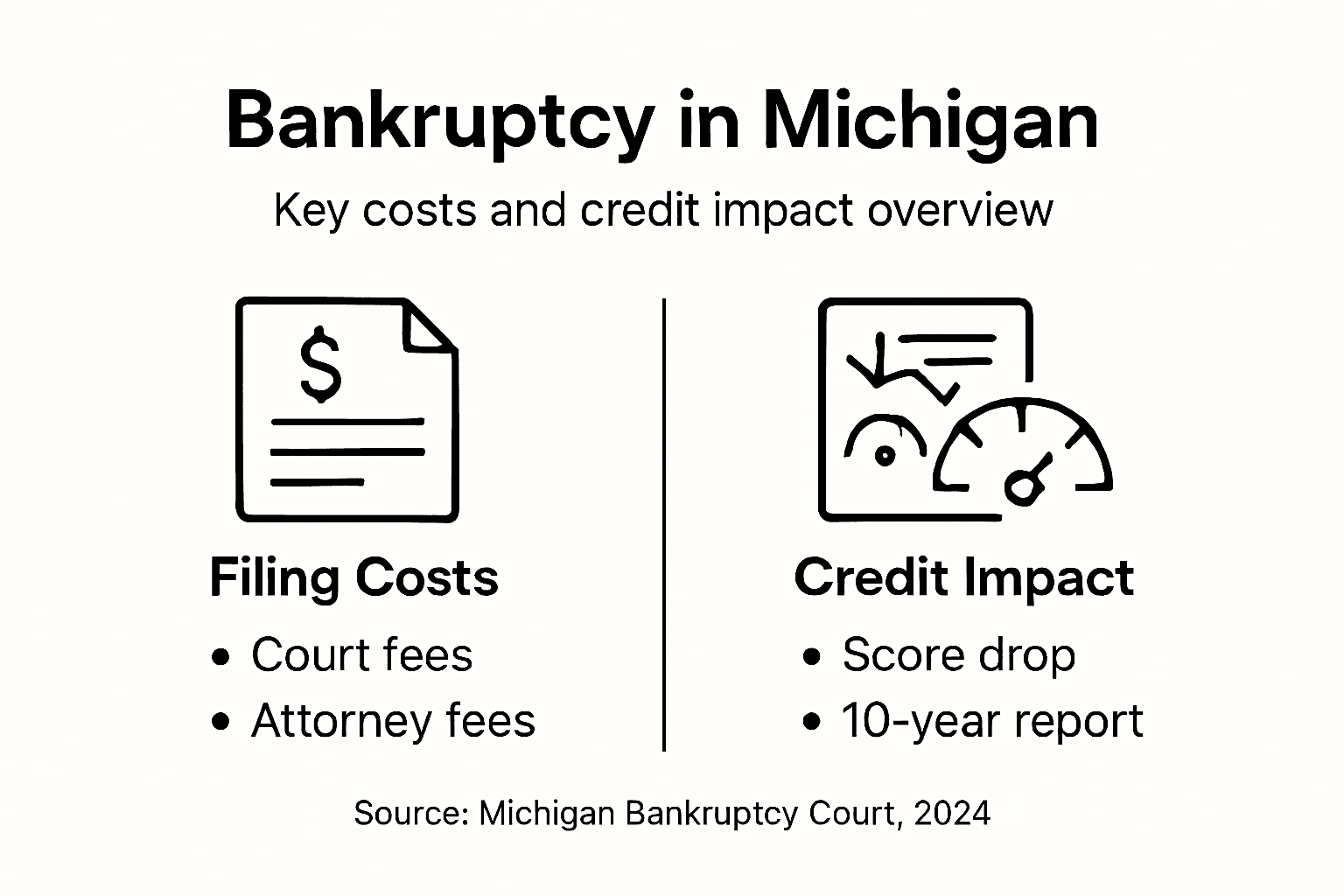
The financial costs of filing bankruptcy in Michigan are concrete. Federal court filing fees for Chapter 7 currently run approximately $338. Chapter 13 filing fees are approximately $313. These are baseline costs, and if you cannot afford them, you can request fee waivers through the court based on your income. Beyond court fees, credit counseling courses cost roughly $50 to $100. Financial management courses run similar amounts.
If you hire an attorney, which most people should consider, typical Chapter 7 cases cost $1,000 to $1,500 in attorney fees. Chapter 13 cases often run $2,500 to $4,500 because they involve managing a multi-year repayment plan. These costs feel substantial when you are already drowning in debt.
However, compare them to the alternative. A single creditor lawsuit can result in judgments exceeding thousands. Garnished wages over years cost far more. For most Michigan families, the bankruptcy investment pays for itself within months through stopped collection activities and eliminated debts. The question is not whether you can afford bankruptcy. The question is whether you can afford not to file.
Risks and Complications
Bankruptcy is not guaranteed success. Several circumstances can derail your case or reduce its benefits. If you fail to disclose all debts, creditors, or assets, the court can dismiss your case or deny your discharge entirely.
If you misrepresent your income or expenses, the trustee can object to your Chapter 13 plan, forcing renegotiation or dismissal. If you accumulate new debts immediately before filing with no intention of repaying them, creditors can challenge the discharge claiming fraud. If you fail to complete required credit counseling or financial management courses, your discharge gets denied.
In Chapter 13, if you miss payments on your repayment plan, the trustee can ask the court to dismiss your case, leaving you unprotected and still owing the full original debt amounts. These scenarios are avoidable through honesty and diligence, but they happen to careless filers.
Another risk involves secured debts like mortgages and car loans. While Chapter 13 lets you catch up on missed payments through your plan, you still owe the underlying debt. Chapter 7 discharges personal liability but the lender can still foreclose or repossess if you stop paying going forward.
Bankruptcy is not a magic eraser for secured debts. It protects you from deficiency judgments on some debts in Michigan, but does not eliminate the creditor’s right to take back the collateral.
Credit Impact and Recovery
Your credit takes a significant hit from bankruptcy. A Chapter 7 bankruptcy stays on your credit report for 10 years. A Chapter 13 stays for 7 years. During this period, your credit score drops substantially. Most people see initial drops of 130 to 200 points, though the exact impact depends on your starting score. A person with excellent credit takes a bigger percentage hit than someone already struggling with scores in the 500s.
However, credit recovery is possible faster than many believe. Within 12 to 24 months of discharge, many filers rebuild scores to the 620 to 650 range by securing a secured credit card, becoming an authorized user on positive accounts, and maintaining perfect payment history. Three years after discharge, scores of 700 or higher become achievable for disciplined filers. Yes, bankruptcy impacts credit significantly. No, it does not permanently destroy your ability to borrow. Lenders understand bankruptcy. Many specialize in post-bankruptcy lending. Interest rates are higher initially, but they drop as your score improves.
The real risk is not bankruptcy itself. The real risk is repeating the patterns that created your original debt. If you discharge $50,000 in credit card debt, then run up new credit cards to the same limit, bankruptcy provides only temporary relief. The process teaches hard lessons about spending, budgeting, and financial discipline. Some people learn these lessons and transform their finances. Others do not.
Your success depends partly on the bankruptcy process and partly on your willingness to change behaviors. Bankruptcy gives you the fresh start. What you do with it determines whether the fresh start leads to genuine financial stability or just a temporary pause before the next crisis.
Pro tip: Before filing, calculate your true financial picture including all debts, all income sources, and all monthly expenses with brutal honesty. Many Michigan residents discover they have more assets or lower disposable income than initially believed, which affects their bankruptcy chapter choice and overall strategy significantly.
Rebuilding Finances After Bankruptcy
Your discharge papers arrive, and suddenly you have something you haven’t had in years: a clean slate. The debts are gone. The collection calls have stopped. The constant financial pressure has lifted. Now comes the part that determines whether bankruptcy was truly transformative or just a temporary reprieve. Rebuilding finances after bankruptcy requires discipline, strategy, and patience. This is where the real work begins. Many people file bankruptcy hoping it solves their problems. The discharge solves your debt problem. Building lasting financial stability solves everything else.
Start by establishing an emergency fund immediately after discharge. Most bankruptcy filers have no savings whatsoever. The first financial disaster that hits without an emergency fund pushes you straight back toward debt. Your goal is not wealth accumulation right now. Your goal is survival. Open a regular savings account and commit to depositing a small amount each paycheck, even if it’s only $25 or $50. After 12 months of consistent deposits, you’ll have $600 to $1,200 sitting between you and financial crisis. This buffer changes everything psychologically. When an unexpected car repair costs $400, you pay for it from savings instead of running up a credit card. That distinction between using savings and accumulating debt defines whether you stay financially stable or repeat the bankruptcy cycle.
Rebuilding Credit and Managing New Debt
Credit rebuilding starts with understanding that some debt is strategic. Not all debt is bad. A mortgage on a home builds wealth. A car loan lets you get to work. Strategic debt differs fundamentally from credit card spending on things you cannot afford. The key is borrowing only what you genuinely need and repaying on schedule.
Within months of your discharge, you’ll likely receive credit card offers. Ignore the high-limit offers. Instead, apply for a secured credit card, where you deposit $500 to $1,000 and receive a credit line equal to your deposit. Use this card for one small recurring expense like a gas station purchase or streaming subscription. Set up automatic payments so the card gets paid in full each month.
This behavior shows lenders you can handle credit responsibly. After 12 months of perfect payment history, many issuers convert your secured card to a regular unsecured card and return your deposit.
Become an authorized user on someone else’s credit card with excellent payment history. A family member with a strong credit score and old accounts can add you to their card without you using it. Their positive history transfers to your credit report, boosting your score. This strategy works because credit agencies see you associated with responsible credit behavior.
Rebuilding your finances after bankruptcy involves multiple strategies working together simultaneously. Credit repair takes time. Most people see scores improve from the initial 500s to the 620 to 650 range within two years. Reaching 700 or higher typically takes three to five years of consistent positive behavior.
Building Long-Term Financial Stability
Beyond credit cards, focus on creating a sustainable budget. Bankruptcy teaches you that income minus expenses must equal a positive number. Sounds obvious until you realize countless people spend more than they earn. A budget is not punishment. A budget is permission to spend money guilt-free on things that matter because you know what you’re spending on things that don’t.
Track every expense for one month. You’ll be shocked. That daily coffee, the subscription services you forgot about, the impulse online purchases. They add up to hundreds. Cut ruthlessly. Direct that freed-up money to your emergency fund until it reaches three to six months of expenses. Then redirect it to investing for your future through retirement accounts like a 401k or traditional IRA.
Consider also the decisions that led to bankruptcy in the first place. Was it job loss? Medical bills? Overspending? Poor financial planning? Each cause requires different solutions. If bankruptcy resulted from job loss, focus on career development and income stability. If medical bills caused it, ensure you have adequate health insurance. If overspending caused it, behavioral change becomes critical. This reflection is uncomfortable but necessary.
Many bankruptcy filers repeat the cycle because they never address the underlying cause. You had the courage to file bankruptcy and get a fresh start. Channel that same courage into honest self-assessment and meaningful change. Your discharge is the beginning, not the end.
Pro tip: Wait at least six months after your discharge before attempting major financial decisions like purchasing a home or making significant investments. This delay allows your credit to stabilize, demonstrates post-bankruptcy responsibility to lenders, and gives you time to prove you can maintain financial discipline without the pressure of major obligations.
Take Control of Your Financial Future with Expert Bankruptcy Guidance
Facing overwhelming debt and financial hardship in Michigan can feel like a heavy burden with no clear way out. Whether you are considering Chapter 7 or Chapter 13 bankruptcy, understanding the process and your options is crucial. Many individuals struggle with fears about losing their home or damaging their credit permanently. These concerns make it hard to take the first step toward relief.
At Frego & Associates, we know that bankruptcy is about strategy and fresh starts, not failure. We help you navigate the means test, exemptions, and repayment plans designed specifically for Michigan residents.
If you want to stop relentless creditor calls and lay a strong foundation for rebuilding your credit, our experienced team is ready to guide you every step of the way. Do not wait until collection actions escalate. Call 1-800-646-0075 now to schedule your free confidential bankruptcy consultation. Take the first step toward financial freedom today.
Frequently Asked Questions
What happens immediately after I file for bankruptcy in Michigan?
Once you file for bankruptcy in Michigan, an automatic stay takes effect immediately, stopping most collection activities such as creditor calls, wage garnishments, and foreclosure proceedings.
What are the main types of bankruptcy available for individuals in Michigan?
The two main types of bankruptcy available for individuals in Michigan are Chapter 7 and Chapter 13. Chapter 7 involves liquidating non-exempt assets to discharge qualifying debts, while Chapter 13 involves creating a repayment plan to pay off debts over three to five years.
Will I lose my home or car if I file for bankruptcy in Michigan?
Not necessarily. Michigan has strong homestead exemptions that can protect your primary residence up to a certain value, and you may be able to keep your vehicle within specific equity limits, depending on your circumstances and the bankruptcy chapter you file.
How does bankruptcy affect my credit score, and how long does it last?
Bankruptcy can significantly impact your credit score, dropping it by 130 to 200 points initially. A Chapter 7 bankruptcy remains on your credit report for 10 years, while Chapter 13 stays for 7 years. However, many filers can rebuild their credit scores within 12 to 24 months after discharge.